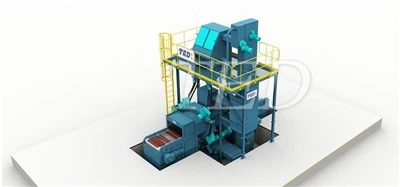
Introduction
In the expansive landscape of modern manufacturing, heavy industry, and specialized surface preparation, efficiency, reliability, and precision are the ultimate currencies. Whether it is preparing structural steel beams for a towering skyscraper, removing stubborn thermal scale from forged automotive components, or cleaning residual core sand from complex foundry castings, the surface treatment process dictates the final quality, structural integrity, corrosion resistance, and aesthetic appeal of the product. At the very center of this crucial industrial process lies a piece of engineering brilliance that often goes unnoticed by the casual observer: the blast wheel.
Often described as the beating heart of airless shot blasting machines, the blast wheel is a high-speed centrifugal device responsible for propelling abrasive media with immense kinetic force, directional accuracy, and controlled volume. Without the continuous, dependable power of a well-engineered blast wheel, industries relying on abrasive blasting would face dramatically slower production rates, significantly higher energy consumption, uneven surface finishes, and excessive operational downtime. Understanding how a blast wheel works is not merely an exercise in mechanical curiosity; it is a fundamental operational requirement for plant managers, maintenance engineers, and technicians looking to optimize production efficiency, minimize operational costs, and extend equipment lifespan in demanding industrial environments.
1. The Core Principle: Centrifugal Force in Action
To truly comprehend how a blast wheel operates, one must first examine the fundamental physics governing its design and execution. Unlike traditional air-blasting systems that rely on large volumes of compressed air to push and accelerate abrasive particles through a nozzle, a blast wheel utilizes centrifugal force. This mechanical mechanism is remarkably similar to how a spinning garden sprinkler throws water outward in a wide circle, albeit engineered to handle heavy steel shot, sharp steel grit, or cut wire particles at incredible rotational velocities.
At its core, the blast wheel consists of a robust, dynamically balanced rotating wheel hub assembly driven by a powerful electric motor. As the motor spins the wheel-often at rotational speeds ranging from 2,000 to over 3,000 revolutions per minute-abrasive media is fed continuously into the center of the wheel assembly. Once the media enters the rotating core, the internal components harness the rotational energy and transfer it rapidly to the individual abrasive particles. These particles are then accelerated outward along radial throwing blades, exiting the periphery of the blast wheel at speeds that can easily exceed 80 meters per second.
This centrifugal approach offers a massive advantage in operational efficiency. By completely eliminating the need for massive, energy-hungry air compressors, a blast wheel can deliver a significantly higher volume of abrasive media per minute while consuming a fraction of the electrical power required by pneumatic systems. The result is a concentrated, high-velocity stream of kinetic energy capable of cleaning, strengthening, deburring, or etching metal surfaces with astonishing speed, economy, and uniformity.
2. Anatomy of a Blast Wheel: Key Components and Their Roles
A blast wheel is a complex assembly of precision-engineered components, each subjected to extreme mechanical stress, continuous friction, and the relentless impact of hard abrasive materials. To appreciate its long-term reliability and high-performance output, we must closely examine the primary parts that make up a standard blast wheel system.
The Wheel Housing and Heavy-Duty Liner Plates
The entire operating assembly is housed within a heavy-duty casing, which is typically lined with replaceable, high-chrome alloy or specialized manganese steel wear plates. These internal liners protect the structural steel housing from the high-speed abrasive stream, absorbing the brunt of stray impacts and extending the overall operational life of the blast wheel unit significantly.
The Runner Head and Throwing Blades (Vanes)
The runner head is the heavy spinning disk to which the throwing blades-frequently referred to as vanes-are securely locked. The blades are the primary contact points for the abrasive media. As the runner head spins at high speeds, the blades guide the abrasive outward toward the periphery. Because these blades endure constant sliding friction and direct centrifugal impact, they are manufactured from exceptionally wear-resistant white iron or alloy steel and must be periodically inspected and replaced as part of routine preventative maintenance.
The Control Cage
Positioned precisely at the geometric center of the blast wheel, the control cage is a stationary, thick-walled cylindrical component featuring a carefully designed slotted opening. The control cage plays an indispensable role in determining the direction and pattern of the abrasive stream. By rotating the control cage slightly via an external linkage, operators can precisely adjust where the abrasive is released onto the inner roots of the spinning blades, thereby shifting the "hot spot" or overall blast pattern to ensure optimal, even coverage of the target workpieces inside the blast cabinet.
The Impeller
Nestled directly inside the control cage is the impeller, which rotates at the exact same high speed as the main runner head. The impeller acts as the primary mechanical feeder. It captures the incoming stream of abrasive media from the central feed funnel and flings it outward through the directional window of the control cage, handing the media off to the fast-moving throwing blades. Without a properly functioning impeller with minimal internal clearance, the abrasive would feed unevenly, leading to premature blade wear, severe internal turbulence, and an erratic blast pattern.
3. The Operational Cycle: From Storage to Propulsion and Recovery
The operation of a blast wheel does not happen in isolation; rather, it is part of a continuous, highly integrated closed-loop recycling system within an industrial shot blasting machine. Understanding this operational cycle highlights how the blast wheel coordinates with auxiliary machinery to maintain high-volume production without interruption.
The operational journey begins in the overhead abrasive storage hopper. Gravity feeds the abrasive media downward through an adjustable metering valve, which regulates the exact volume of media allowed to enter the blast wheel per minute. This regulation is critical for process control; feeding too little media drastically reduces cleaning efficiency and leaves workpieces improperly treated, while overloading the blast wheel can cause choking, abnormal mechanical vibration, excessive internal wear, and potential motor stalling.
Once past the metering valve, the abrasive falls directly into the central feed spout of the blast wheel. It drops into the rotating pockets of the impeller, which catches the particles and subjects them to radial acceleration. The impeller forces the media through the directional window of the control cage, depositing the particles directly onto the inner root of the rapidly spinning throwing blades.
As the media slides outward along the hardened face of each blade, it undergoes intense acceleration. By the time the abrasive reaches the outer tip of the blade, it has attained maximum velocity. The particles leave the blast wheel in a tightly focused, high-energy stream, hurtling across the blast cabinet to impact the surface of the workpiece.
Following impact, the spent abrasive-along with removed scale, rust, paint, and fine dust-falls to the bottom of the machine hopper. A sophisticated system of screw conveyors, bucket elevators, and air wash separators cleans the abrasive, removing contaminants and returning the reusable media to the overhead storage hopper, ready to be fed back into the blast wheel once again in a continuous cycle.
4. Factors Influencing Performance, Efficiency, and Maintenance Best Practices
Because a blast wheel operates under exceptionally harsh mechanical and abrasive conditions, its performance, efficiency, and lifespan depend heavily on proper maintenance, correct material selection, and strict operational discipline. Several key factors dictate how efficiently a blast wheel performs in an industrial setting.
First, the choice of abrasive media plays a monumental role in component longevity. Steel shot, steel grit, cut wire, and stainless steel particles all possess vastly different densities, hardness levels, and physical shapes. The hardness and size of the media directly impact how quickly the blades, impeller, and control cage wear down. Operating a blast wheel with heavily contaminated or broken-down abrasive can drastically accelerate wear rates, as jagged dust and fine debris act like an aggressive lapping compound inside the high-speed mechanism.
Second, precise mechanical alignment and dynamic balance are non-negotiable. Because a blast wheel spins at thousands of RPMs, even a minute weight imbalance caused by uneven blade wear can induce severe, destructive vibrations. These vibrations can quickly damage motor bearings, crack housing structures, and lead to catastrophic equipment failure. Therefore, throwing blades should always be replaced in complete, factory-matched weight sets to maintain perfect rotational balance.
Finally, routine inspection protocols are essential for minimizing unplanned downtime. Maintenance technicians must regularly check the residual thickness of the throwing blades, examine the critical clearance gap between the impeller and the control cage, and inspect the internal protective liners. Catching a worn component early prevents secondary damage to other parts of the blast wheel assembly, ensuring predictable, reliable performance shift after shift.
Conclusion
The blast wheel stands as a remarkable testament to industrial engineering-a deceptively simple concept scaled up through precision manufacturing, advanced metallurgy, and aerodynamic design to conquer some of the toughest challenges in modern surface preparation. By harnessing the raw power of centrifugal force, the blast wheel transforms electrical energy into a controlled, high-velocity torrent of abrasive media, cleaning, strengthening, and finishing metals with unmatched speed and efficiency.
As manufacturing technologies continue to evolve, the demand for higher productivity, lower energy consumption, and greater precision will only intensify. Future innovations in blast wheel design will likely focus on even more wear-resistant alloy compositions, smart IoT-enabled vibration and wear monitoring sensors, and optimized internal geometries to reduce energy loss and maximize throw efficiency. Yet, regardless of these technological refinements, the fundamental role of the blast wheel as the beating heart of surface treatment machinery will remain unchanged. For industrial enterprises striving for operational excellence, mastering the mechanics, physics, and maintenance of the blast wheel is not just an operational necessity-it is the definitive key to unlocking superior product quality, reduced operating costs, and long-term competitive advantage in the global marketplace.